In 2018, a handful of creators started posting short videos on a Chinese app most people dismissed as kids dancing. Three years later, TikTok had reshaped the entire creator economy. The creators who moved early — before the algorithm matured, before the competition arrived, before the monetisation tools existed — built audiences that late adopters are still trying to replicate.
Something similar is happening right now on WhatsApp. Not the messaging app you use to text your family, but the broadcast platform that 500 million people started following within months of its launch. WhatsApp Channels is the fastest-adopted feature in Meta's history, and most creators haven't noticed yet.
Meanwhile, Telegram — the platform many creators depend on for direct audience access — is facing a year that is testing its foundations.
The WhatsApp Channels tailwind
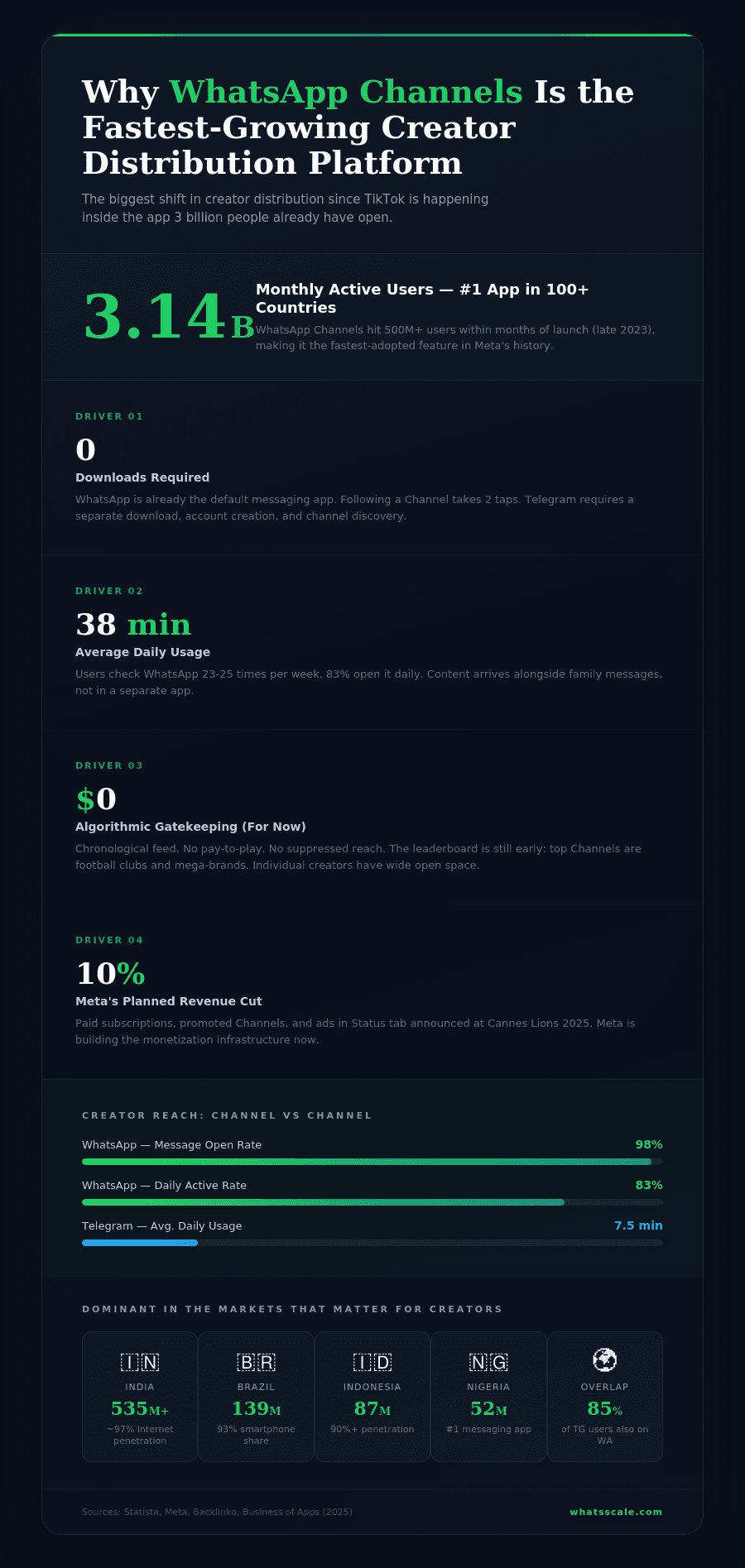
WhatsApp isn't just big. It is the default communication layer for over 3 billion people across 100+ countries. When Meta launched Channels inside this ecosystem, they didn't need to convince anyone to download a new app. Following a Channel takes two taps. Your content lands in the same inbox as family messages.
The engagement numbers reflect this structural advantage. Users open WhatsApp an average of 23 to 25 times per week, spending 38 minutes daily. 83% open the app every single day. Compare this to Telegram, where average daily usage sits around 7.5 minutes — and the platform requires a separate download that most of your potential audience will never complete.
The geographic distribution matters, too. WhatsApp dominates in the exact markets where the creator economy is booming: India (535M+ users), Brazil (139M), Indonesia (87M), Nigeria (52M). These aren't niche markets. They are the next wave of the creator economy.
Meta's monetisation roadmap: At Cannes Lions 2025, Meta announced paid subscriptions with a 10% revenue cut, promoted Channels for discovery, and ads in the Status tab. The playbook is familiar: build the tool, attract the creators, introduce the algorithm, take a cut. They did it with Instagram. They're doing it with WhatsApp — and right now the feed is still chronological with no algorithmic gatekeeping.
What changed for Telegram creators
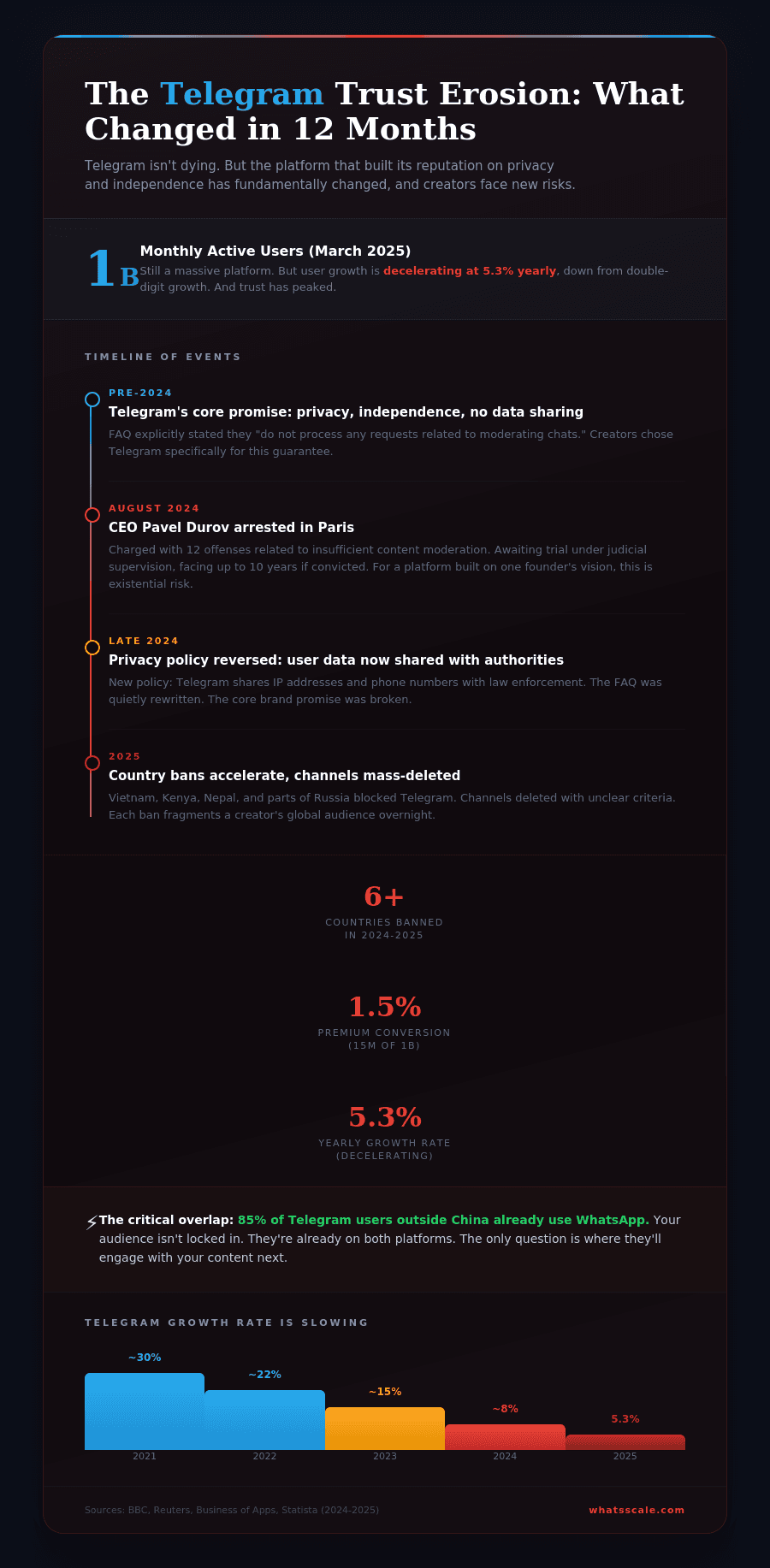
Let's be direct: Telegram isn't dying. It hit 1 billion monthly active users in March 2025. That's a massive platform with a loyal creator community.
But the ground is shifting. In August 2024, CEO Pavel Durov was arrested in Paris and charged with 12 offences related to insufficient content moderation. He's currently awaiting trial under judicial supervision, facing up to 10 years if convicted. For a platform built almost entirely on one founder's vision and reputation, the legal uncertainty creates a dependency risk that simply didn't exist before.
Then came the policy reversal. Telegram's FAQ — which once explicitly stated they "do not process any requests related to moderating chats" — was quietly rewritten. The new policy shares IP addresses and phone numbers with law enforcement. The platform that built its brand on resisting government data requests began cooperating with authorities. For creators who chose Telegram specifically for its privacy guarantees, the core brand promise was broken.
| Signal | Detail |
|---|---|
| CEO legal exposure | Pavel Durov arrested Aug 2024, facing up to 10 years |
| Privacy policy reversal | Now shares IP + phone numbers with law enforcement |
| Country bans (2025) | Vietnam, Kenya, Nepal, parts of Russia |
| Growth deceleration | YoY growth dropped from ~30% (2021) to 5.3% (2025) |
| Weak monetisation | Only 15M premium subscribers out of 1B users (1.5%) |
Country bans accelerated through 2025. Each ban fragments a creator's global audience overnight. Channels were mass-deleted with unclear criteria. And the one statistic that puts the migration opportunity in perspective: 85% of Telegram users outside China already use WhatsApp. Your audience isn't locked in. They're already on both platforms.
Why the transition is harder than it should be
If the audience is already on WhatsApp, why haven't more creators made the move? Because WhatsApp Channels is still missing the tooling that Telegram creators take for granted.
❌ What WhatsApp Channels is missing
- • No native scheduling
- • No analytics dashboard
- • No CRM integration
- • No cross-posting
- • No automation
- • Content auto-deletes after 30 days
- • No migration path from Telegram
✅ What Telegram has
- • Built-in post scheduling
- • Detailed view analytics
- • Bot API for automation
- • Permanent message history
- • Cross-posting bots
- • RSS integrations
- • Silent messages
The gap is clear: WhatsApp has the reach, Telegram has the tooling. Creators need both — and they need a bridge between them.
The case for moving now
Every creator platform cycle follows the same arc: early adopters build audiences before the algorithm arrives, before pay-to-play kicks in, before the competition saturates. WhatsApp Channels is at the beginning of that arc right now.
Meta's playbook is predictable. The 12 to 18 month window before paid subscriptions fully roll out, before promoted Channels creates a paid discovery advantage, before algorithmic ranking replaces the chronological feed — this is when early creators establish themselves.
Right now, the leaderboard is dominated by football clubs and mega-brands. Individual creators, educators, and niche experts have wide open space. That window closes.
How to automate the transition with Make
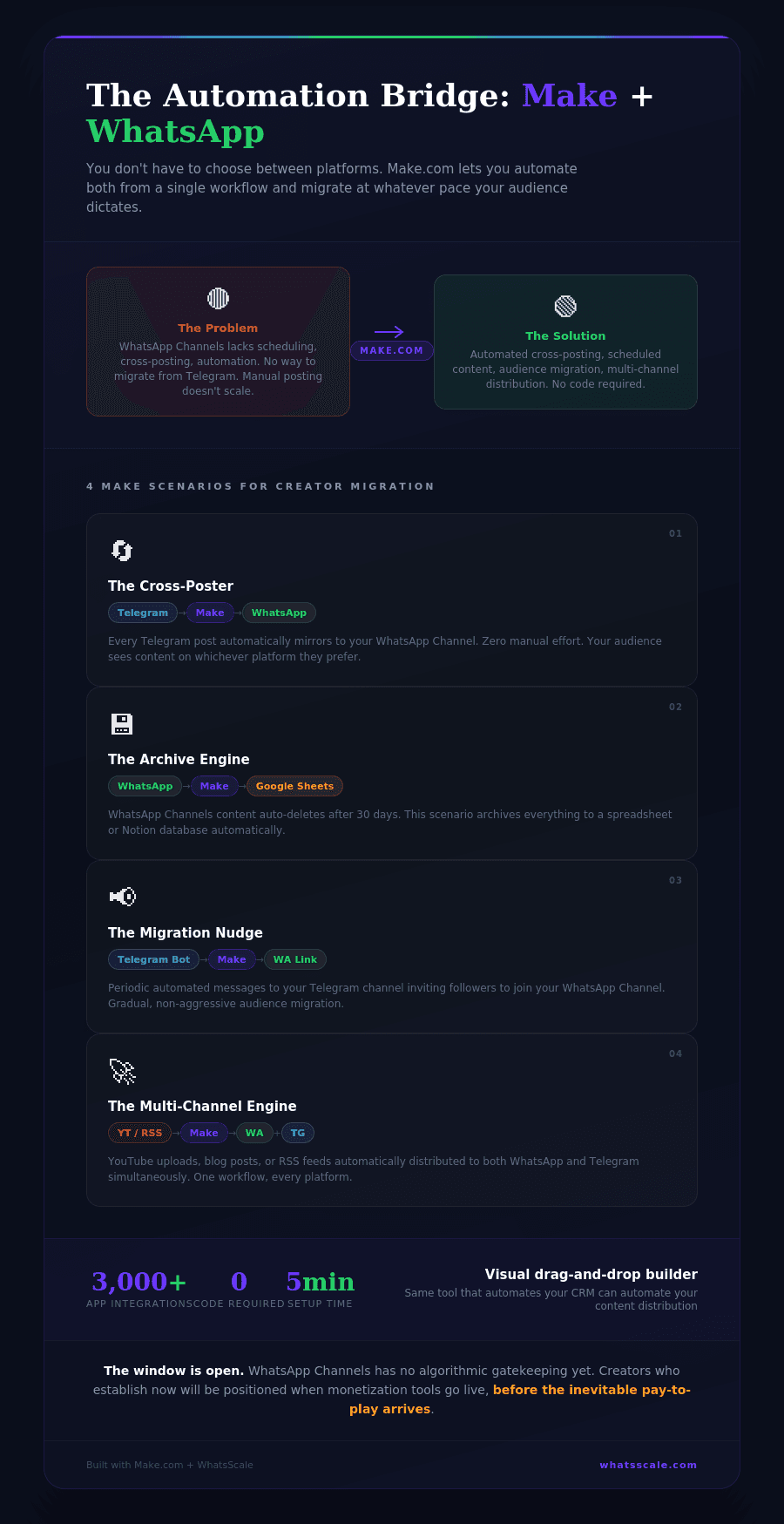
The gap between WhatsApp's reach and its tooling isn't permanent — it's an automation opportunity. Make has native integrations with both Telegram Bot and WhatsApp Business Cloud. Add WhatsScale's Make integration, and you can build scenarios that solve the entire transition — without writing a line of code.
Here are four workflows that bridge the gap:
The Cross-Poster
Every Telegram post automatically mirrors to your WhatsApp Channel. Zero manual effort. Your audience sees content on whichever platform they prefer.
Make trigger: Telegram Bot → Watch Updates → WhatsScale → Send Text to Channel
The Archive Engine
WhatsApp Channels content auto-deletes after 30 days. This scenario archives everything to a Google Sheet or Notion database, so nothing disappears.
Make trigger: WhatsScale → Watch Channel Messages → Google Sheets → Add Row
The Migration Nudge
Periodic automated messages to your Telegram channel invite followers to join your WhatsApp Channel. Gradual, non-aggressive audience migration.
Make trigger: Schedule → Telegram Bot → Send Message (with WhatsApp Channel link)
The Multi-Channel Engine
YouTube uploads, blog posts, or RSS feeds automatically distributed to both WhatsApp and Telegram simultaneously. One workflow, every platform.
Make trigger: RSS → Router → WhatsScale (WhatsApp) + Telegram Bot simultaneously
The window is open
The opportunity on WhatsApp Channels is real and growing. The risks on Telegram are documented and increasing. The audience overlap means migration has zero friction on the consumer side — they're already there.
Creators who establish their WhatsApp Channel presence now will be positioned when monetisation tools go live, before the inevitable algorithmic gatekeeping arrives.
You don't have to abandon Telegram. But you do need to be where your audience is going, not just where they've been. With Make and WhatsScale, you can automate both platforms from a single workflow and migrate at whatever pace your audience dictates.